Through Reading
- Home
- Why Is Reading Important
- Sounds Letters Make
The Sounds Letters Make
By Glenn and Diane Davis
Some consider English one of the most difficult languages to learn. That may be true, and English borrows words from many other languages and even "dead" languages, but reading English does not need to be difficult. The English language has 26 letters in its alphabet, and most experts believe there are 44 sounds letters make [The experts debate anywhere between 39 and 45, but most accept 44]. If there were 44 letters in our alphabet, reading would be simple! Each letter would have its own sound. However, since there are 44 sounds and only 26 letters, some letters must make more than one sound. [Note: Before teaching letter sounds, the student should know the alphabet in the correct order. See Teaching The Alphabet.]
The Sounds Letters Make
Ready for the good news? Sixteen letters almost always make the same sound! This means there are only ten letters that make more than one sound. The sixteen letters are what we call constant consonants. These letter sounds can be learned quickly. Then the remaining ten letters and their various sounds can be learned.
The sixteen constant consonants are:
B D F H J K L M N P Q R T V X Z
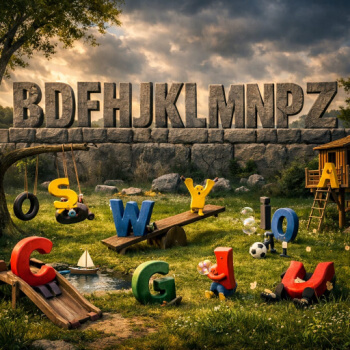

There are five more consonants, C, G, S, W, and Y, and they make more than one sound. Three of them only make two sounds, so that's not difficult. Phonics provides insight into which sounds these letters make and when. Learning the few simple rules that apply to them removes the mystery.
The five regular vowels, A E I O U, make up the rest of our letter sounds. An easy way to teach children to remember these regular or primary vowels is the sentence: Lady [AE] I [I] owe [O] you [U] some money. Vowels have their own long and short sounds, as well as being copycats. The short sound is the usual sound of the vowel.
Before we go on, we should note that both “W” and “Y” can sometimes act as vowels, as well as consonants. They can be very versatile letters!
Some programs present a complicated and unnecessary idea when discussing the hard and soft sounds of certain letters. What is a hard or soft sound? Can you feel sound? The sounds letters make are not hard or soft, and teaching them this way makes learning to read unnecessarily difficult. For example, some people talk about the hard or soft sound of “C.” It is much easier to say that “C” sometimes copies “S” and sometimes copies “K.” Then the simple rule needs to be given, explaining when to know which letter “C” is going to copy. This is an essential rule since “C” is in about 25% of English words. “C,” by the way, is the only letter which has no sound of its own. It is a true copycat.
After the student has mastered the main letter sounds, it is important to make sure they know all the sounds a letter can make. For example, did you know the letter “A” actually makes nine sounds [or, to be exact, 8 sounds, and it can be silent]? How many do you know?
Sometimes an emphasis is placed on blended sounds. Most blended sounds will come naturally as a person sounds out the individual letter sounds and puts them together. Also, breaking longer words into syllables is helpful.
At Read With Confidence, we teach all the sounds of the letters and the phonetic rules that go with them. This is done in easy steps, so the reading comes almost automatically. Sign up for our complete reading program now. This is not a tutoring program, but a course that will train students in the skill of reading. It doesn't matter how old a student is [preschool through adult]; they all start at the same place and work their way through the course. Some will go faster than others, but all will succeed.

Diane Davis is a Reading Specialist focused on phonics instruction and helping parents support children as they learn to read. With more than 20 years of experience, she has helped over 100 students build stronger reading foundations and confidence. Readers are welcome to explore Diane’s testimonial page. In her free time, she enjoys reading Christian romance and suspense novels.